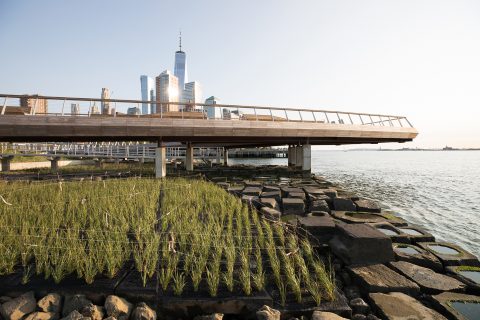
The Hudson River Park Trust opens Pier 26 today, the first
new public pier to open in the four-mile-long Hudson River Park in a decade.
Within the zone initially identified for 9/11 recovery, the
pier now will serve as an open space resource for New Yorkers as the city works
to recover from the ongoing pandemic.
Located in Tribeca between Hubert and N Moore Streets, Pier
26’s most unique feature is a Tide Deck – an engineered representation of a
rocky tidal marsh – for educational and ecological programming.
Along with indigenous plantings representing varied coastal communities, the Tide Deck is intended to heighten awareness of the wildlife and habitat found within the Park and the Estuarine Sanctuary included within its borders.

Other features on the new pier include a sunning lawn, a
sports court for children’s play, and multiple lounge areas for enjoying river
views.
The construction of the $37.7 million pier was funded by
Citi, the Lower Manhattan Development Corporation (LMDC) and the City of New
York. Design funds for the tide deck were provided by New York State’s
Environmental Protection Fund.
“The incredible transformation of Pier 26 into a world-class
ecological, educational, and recreational resource is a testament to the
corporate, civic, and community leadership behind this project and an example
of the powerful role public-private partnerships can play to help improve
quality of life for communities,” said New York State Department of
Environmental Conservation Commissioner and Hudson River Park Trust Chair Basil
Seggos.
“The millions of visitors drawn to Hudson River Park each year will enjoy the pier’s state-of-the-art amenities for generations to come, and with improved access countless children now have the opportunity to learn unforgettable lessons about the Hudson River.”

“Seven years in the making, we are proud to open this
entirely unique pier at a time when Hudson River Park has taken on new
importance for so many in the face of the current health crisis — providing a
much-needed oasis in a city with limited green space,” said Madelyn Wils,
President and CEO of Hudson River Park Trust.
Pier 26 was designed
by the landscape architecture firm OLIN. Its 15,000 s/f Tide Deck – the first
of its kind in New York City – has been planted with native shrubs, trees and
grasses intended to mimic the wetlands that once existed along the Hudson River
shoreline and is part of a coastal area that regularly floods with the daily
tidal cycle, giving plants and wildlife vital nourishment from the river.
An elevated cantilevered walkway above the Deck provides city
and river views, while the Deck itself will be accessible for guided tours and
educational experiences led by the Park’s staff.
The riverfront access point will help support the
educational programming offered by the Trust’s environmental education and
scientific programming arm, the River Project, for more than 30,000 kids and
adults every year.
Pier 26’s upland is home to the City Vineyard restaurant and
wine bar, and Downtown Boathouse, which has provided free kayaking for half a
million people since its inception.
In the future, the upland area immediately east of Pier 26 will also include a specialized science-themed playground of more than 4,000 s/f, designed by OLIN and with play features by the Danish playground design firm Monstrum, which helped design Hudson River Park’s pipefish playground in Chelsea Waterside Park.

The play area will include larger-than-life play features in
the forms of native and endangered Sturgeon species found in the Hudson River.
The playground will join the Trust’s planned estuarium on the adjacent upland
to complete the Tribeca section of Hudson River Park. The estuarium – a
research and education center featuring live Hudson River fish to be run by the
Trust’s River Project and focused on river ecology – is in its fundraising
stage.
The opening of Pier 26 comes as the Trust spearheads
approximately $1 billion in public/private partnerships in ongoing construction
toward completion of the Park. Construction is nearing completion on Little
Island, the planned public park pier and performance space once known as Pier55
and expected to open next summer. That project was made possible through
funding from the Diller-Von Furstenberg Family Foundation, and represents the
largest single donation to a park in the history of the State, along with the
City of New York.
Work is also ongoing at Pier 57, a mixed-use development by
RXR Realty/Youngwoo and anchored by Google, which will include more than three
acres of public open space, including a rooftop park and perimeter esplanade –
also expected to open next year.
At the same time, the Trust plans to break ground by next
spring on three additional public park projects: Gansevoort Peninsula, which
will provide direct waterfront access for the public with a resilient
beachfront and with the largest single greenspace in Hudson River Park; Pier
97, which will include a lawn, playground, sunset plaza, and youth soccer
fields, along with an esplanade connection to Riverside Park South; and a
reconfiguration of Chelsea Waterside Park.
Finally, the Whitney Museum of American Art is building
“Day’s End” by David Hammons on the southern edge of Gansevoort Peninsula in
partnership with the Trust, which will be one of the country’s largest public
art projects upon completion late this year.
The opening of Pier 26 marks an important post-9/11
rebuilding milestone for Lower Manhattan. In 2010, the Lower Manhattan
Development Corporation funded construction of piers 25 and 26 as part of its
ongoing rebuilding efforts in the neighborhood. The adjacent Pier 25 is the
most heavily used pier in Hudson River Park.