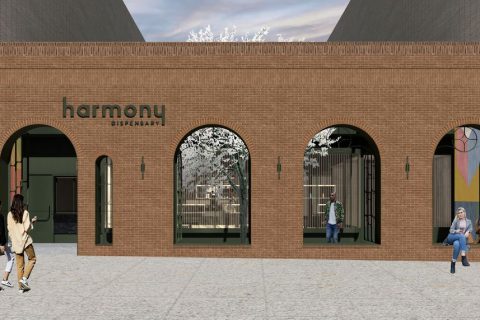
The city’s Planning Commission has recommended a rezoning of Industry City in Brooklyn that proponents says could create over 20,000 new jobs.
“After considering the facts, including that the proposal will lead to the creation of 20,000 good-paying jobs and generate $100 million in annual tax revenue, the City Planning Commission has now recommended that the plan be approved,” said Andrew Kimball, CEO of the 35-acre waterfront campus that houses some 550 companies.

“We will continue to
make the case for this proposal and look forward to working with the City
Council and other community stakeholders as the approval process enters its
final phase.”
The decision came
despite opposition led by local council member Carlos Menchaca to the plan by
the property’s owners, Belvedere Capital and Jamestown Properties, to add one
million square feet to campus with more than 600,000 s/f of classroom space, more
than 900,000 s/f of retail space and increase the size of the property from 5.2
million s/f to 6.5 million s/f.
In giving her
backing to the plan, CPC chair Marisa Lago’s said she believed the development would
help rather than hinder the neighborhood.
She said, “Historically,
the residents of New York City’s lower-income communities, and our Black,
Indigenous and People of Color communities are the hardest hit by economic
shocks – and they have for too long been left to fend for themselves. I believe
that the Industry City proposal can help us to stop this cycle of neglect and
inequity – help us to right a historical wrong.”
The planning chief
said COVID-19 had brought the need for stable, local jobs into sharp focus. “We know that for our city to function, we
need both warehousing space and space for job-dense uses close to where New
Yorkers live.
“The Industry City proposal can provide both – without public subsidies or public capital investments on the underutilized, privately-owned 30 acre facility – but only if we update our long-outdated zoning.”

With the city’s
unemployment standing at 20.4 percent – five times that of last year – Lago said,
“City government, in partnership with communities and the private sector, must
never take its foot off the pedal of economic development. We must double down
and create good jobs for New Yorkers at all skill levels – near where they live.”
Industry City is located
within an area that the city has worked to transform into modern manufacturing
hub that includes Brooklyn Army Terminal, a Made in New York campus, waterfront
open spaces, and a wind-power assembly hub.
However, Industry
City’s zoning restricted the manufacturing and commercial development approvals
the owners said they require to reinvent derelict warehouse buildings on the
site, formerly known as Bush Terminal, in a $1 billion transformation.
Supporters say repurposing
the long dormant shipyard properties would attract more new business like e-bike maker, Jetson, TV and film production
companies and food concepts to create “a job-intensive hub for manufacturers,
innovators, and entrepreneurs.”
Following today’s
approval from the CPC, Lago said in a prepared statement, “The work to
revitalize Brooklyn’s waterfront has been – and will continue to be – done in
close partnership with local communities and elected officials.
“Industry in NYC is
undeniably evolving. It’s smaller, it’s more high-tech, and its jobs afford a
talented local workforce a direct pathway to good paying jobs.”
A coalition of
business leaders that includes the Real Estate Board of New York (REBNY), the
NY Building Congress and the Association for a Better New York hailed the
progress of the rezoning.
“Industry City is
not simply offering the “promise” or “potential” of new jobs, but has already
proven themselves good neighborhood partners with a track record of economic
development success (and all with private investment and zero public resources),”
said the coalition in a letter to Council Speaker Corey Johnson.
“Since taking over
the property, they’ve grown from 150 businesses and 1,900 jobs to 550
businesses and more than 8,000 jobs. This rezoning will facilitate the growth
of more than 12,000 additional jobs and generate $100 million a year in
desperately needed local tax revenue.
“No other private redevelopment project anywhere in the City of New York can match either this record of growth or its potential for continued investment and job creation.”

However, Council
Member Carlos Menchaca, who represents Sunset Park in the City Council, said he
will continue to oppose the plan as it moves through the final stages of its
application with the City Council.
Lambasting the CPC
decision, Menchaca said, “There is scant evidence to suggest that Industry City
has created jobs for the working-class immigrant families who the Commission
believes will benefit from the rezoning. More damning still, not a single
commissioner wondered why Industry City needs a rezoning when they have managed
to create thousands of jobs already.
“Industry City is
backed by a consortium of multi-billion-dollar global investors whose wealth
continues to grow despite the economic despair afflicting Industry City’s
neighbors. More than one million square feet at Industry City sits vacant. They
are entirely capable of further investing and developing the site without a
rezoning. They know it and we know it – Industry City can create thousands of
jobs without this rezoning.
“But perhaps more
disturbing than what the Commission said is what it did not say. Nowhere was
there an acknowledgement of the Sunset Park community’s deepest concern, which
is that the rezoning will cause a rise in rents and displacement of its
working-class, immigrant families.
“That this
displacement will occur is a demonstrable fact of any large-scale rezoning or
development project in New York City’s history. For the Commission to ignore
Sunset Park’s main concern with the project, while simultaneously declaring
that these residents will benefit most from the rezoning, will go down in
history as one of the most tone-deaf remarks during this unprecedented economic
crisis.”
Menchaca added, “Planning Commissioners are appointed officials—they have done their job, now the Council must do ours. As elected officials, we have been called by our neighbors to lead in times of crisis. We must have the courage to listen, to learn from history, and to lead an economic recovery that refuses to repeat the mistakes of the past and instead fights for a more just and resilient future.”
A City Council spokesperson said, “Now that this application has been approved by the CPC, the Council will review with community feedback in mind.”